Kunyuan Li
(she/her/they)
This work draws inspiration from my ongoing reflections on online feminism in everyday life, and has also been influenced by Sara Ahmed’s book Living a Feminist Life.
As a Gen Z creator living and studying abroad, I keenly feel the intense clash between my gender identity and the contemporary media landscape.We are living in an age of information overload. Far from becoming the safe haven we once imagined, cyberspace has increasingly become a megaphone amplifying misogynistic discourse, driven by the combined forces of algorithms, platform structures and the culture of online anonymity.
Compared to the real world, hostility online often spreads more directly and rapidly. What is even more distressing is witnessing women attacking other women online—including some who have publicly advocated for feminism, yet still wield language as a weapon against other women in the digital realm. Regardless of gender, the stereotypes and emotional pressures imposed upon individuals are suffocating.
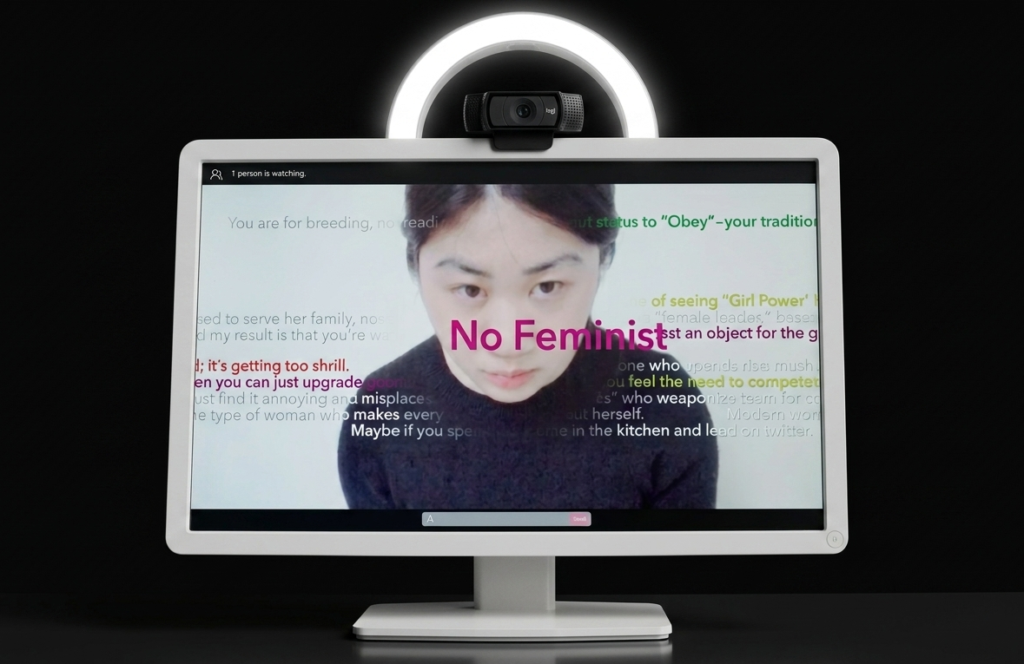
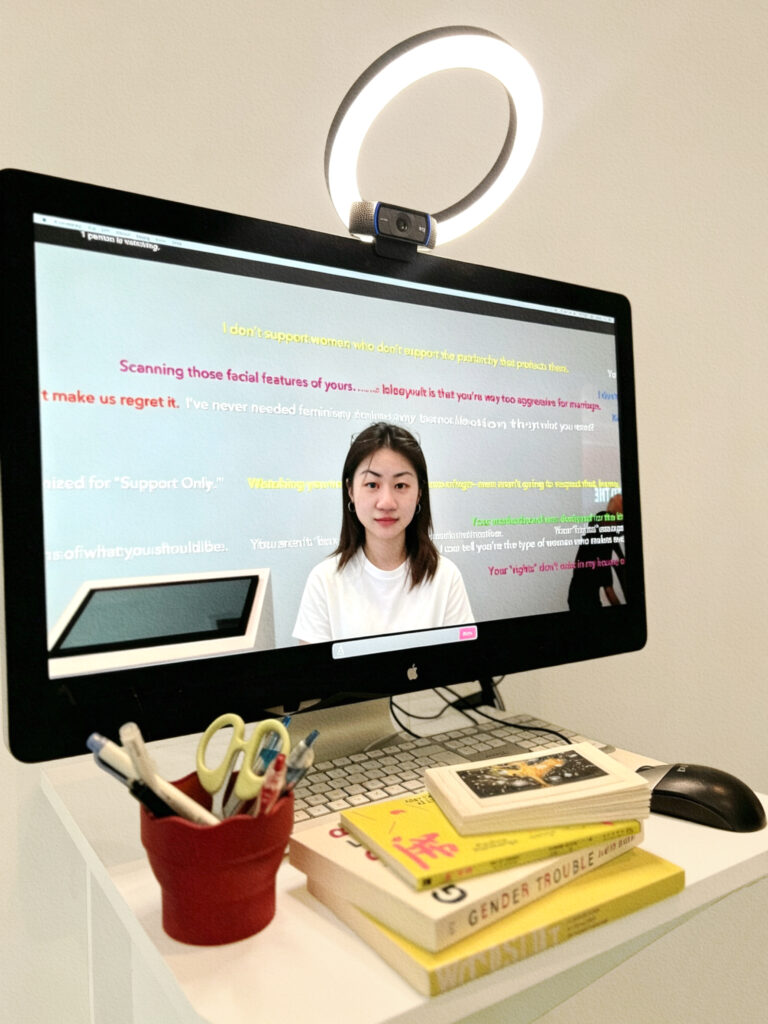
Against this backdrop, I created the installation ‘Cyber Room’.which aims to visualise the oppressive atmosphere of the online environment. Utilising the Processing software, the work simulates the real-time comment streams commonly found on social media platforms, constantly refreshing to recreate the suffocating barrage of information and emotional pressure characteristic of internet culture. Simultaneously, the webcam embedded within the work functions as part of a mechanism of gaze, transforming the audience from mere observers into subjects of scrutiny and judgement. Through this immersive environment, the installation not only exposes the phenomenon of misogyny amongst women but also allows the audience to personally experience the anxiety, suffocation and constant surveillance inherent in the digital space.
However, the work’s purpose is not limited to exposing misogyny. Beyond the screen, I seek to construct a more private, intimate space to serve as an emotional counterbalance to online hostility. This space is no longer confined to a framework of criticism and oppression, but shifts towards encouragement, support and empowerment, exploring whether women can forge more sincere and empathetic connections. Through this contrast, the project aims to guide the audience in reflecting on gender relations, mechanisms of the gaze and the flow of emotions in the internet age, whilst simultaneously reconstructing a narrative for women that is more empathetic and empowering.