Pien Overing
(She/her/they/them/have a good day)
I’m on a plane, reading a book on user experience.
The guys behind me are drinking Jack and Cokes.
Their mate, who is originally sitting somewhere in the back,
sits down in the aisle next to me and tells them:
Five pints are the key to flying.
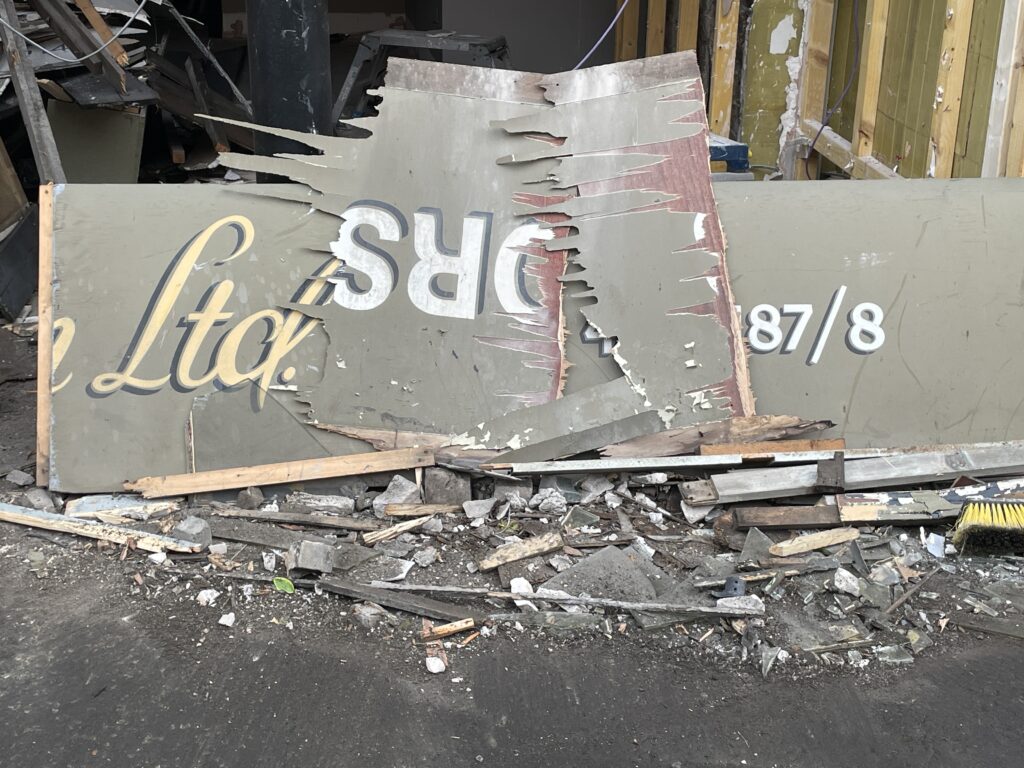
Pien Overing is a sculptor. Overing’s slightly minimalist practice is executed by collecting found material, editing and making three-dimensional collages. Overing is not interested in the reconstruction of unavailable materiality; instead, a taken image becomes material. Recent works are made from fluorescent lampshade covers, shop signage, discarded wood, and car trailer parts. Thematically, the work focuses on feminist practices, questions authorship, gender, labour, systems of supply, algorithmic processes, and electronic systems like automated information / AI, with a fundamental focus on collaboration and circularity.
“Pattern exhaustion is a term from anthropology, of when there is an artistic decline in cultures that reuse pottery patterns rather than diversifying. … In the field of AI, pattern exhaustion occurs in the form of model collapse when AI models are trained on data from other models, making the generated content more uniform.”1
Overing connects directly with the history of greater Glasgow and with the history of women’s labour in the 20th century. Pointers are life-size copies of the minute hands from the old Singer factory in Clydebank. In the case of Pointers, the source is an image from the 1920s, six women labourers hold up the replacement minute hand in the yard of the Singer factory.
I’m not a ruler, but I rule
I am centimetres
1. Goeting, Marijke, and Maaike van Neck, eds. Algorithmic Imaginations: Critical Reflections on AI in Art and Design Practice. ArtEZ Academia, volume 42. ArtEZ Press, 2025.