Eliza Wagener
‘blue city rhymes’
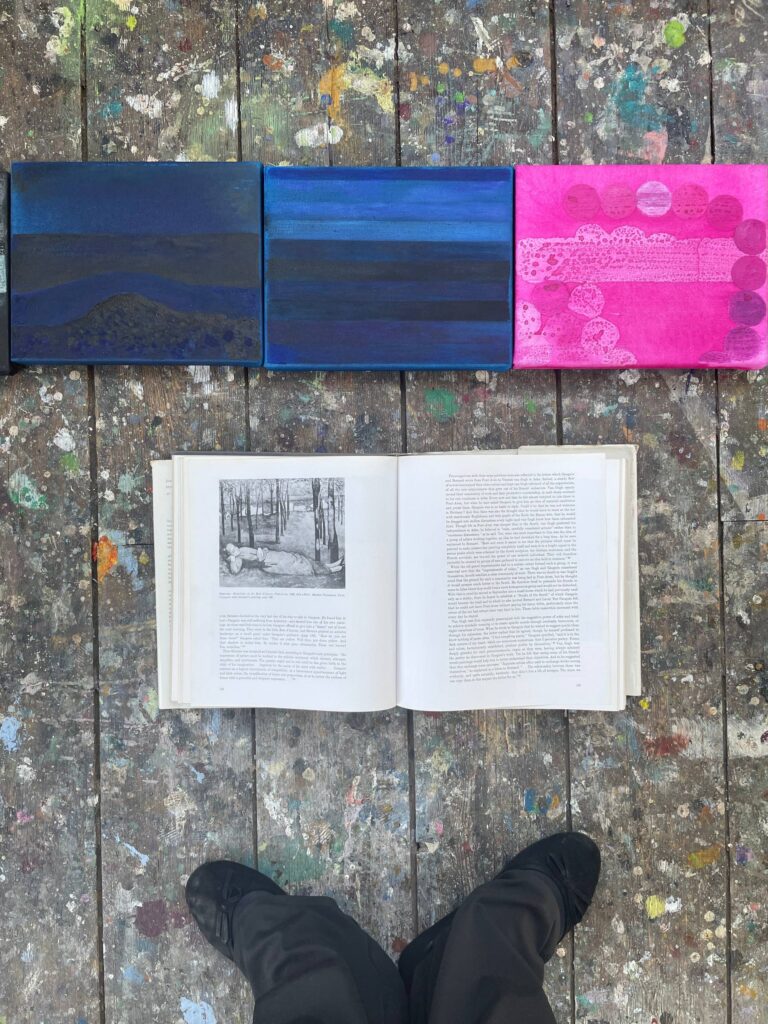
The horizon localises figures. Be it in the shimmering, colourful paintings of Frank Walter (1926- 2009), where the horizon provides an impetus for a graphic interplay that, in its progression, offers the potential to become Nozkowski-esque compositions. Or in Léon Spilliaert’s (1881-1946) paintings of the Bay of Ostend. In Spilliaert’s case, the horizon situates the figures in a zone between oneself and the uncertainty of the world behind them. With Spilliaert, the horizon occasionally becomes blurred—more a gradation or a gradient curve than a sharp boundary.
It is quite different for the English painter Adrian Morris (1929-2004). In Morris’s work, the minimally curved, slightly buckling, and evidently hand-drawn horizons are sharp. They are sharp, yet not entirely ‘hard-edge’, offering a view of juxtaposed planes of colour. Sky blue meets ochre, fra- med by 70s orange or midnight blue, by greyish brown or the colour of sandstone or desert. Morris always leaves the question somewhat open as to whether this means sky is meeting earth, framed by Space Age windows. His paintings contain no figures. I, the viewer, simultaneously perform a helicopter flight over a deserted wasteland, while standing before, within, or above a landscape, experiencing how the horizon rises ever higher, almost to my neck, while simultaneously receding further from me.
The distance to the horizon depends primarily on the eye level of the observer; for an adult at the seaside with an eye level of approximately 1.70 m, it is about 4.7 kilometres. This distance increa- ses with a higher vantage point—to roughly 13 km at a height of 10 m, or over 200 km from an aircraft. With every step I take towards the horizon, it moves one step away from me. I am about 1.60 m tall, with an eye level of roughly 1.50 m (practical when hanging paintings). This means that on a perfectly flat plane, I can see for about 4.4 kilometres.
The horizon is both freedom and limitation. Freedom, because it suggests a vastness that I, as an artist living in an urban environment, sometimes lose touch with in my daily life. There, I am surrounded by wall after wall. The greatest expanse, the highest form of escapism I can experien- ce, is a glance into the windows lining those walls. I am reminded of Martin Wong’s (1946-1999) paintings of brick facades—of house walls, window fronts, brick grids, and prison cells. Worlds accessible to me and worlds closed off. Freedom versus confinement; the absurdity of parallel realities in urban spaces, separated only by walls.
In MoMA, there hangs a painting by Wong from 1986. Houston Street shows a life-sized, shuttered storefront in the then-desolate and crime-ridden Lower East Side of Manhattan. The shop is bol- ted, the shutters are down; there is no clue for me as to what lies behind them—I can only guess. Houston Street is so special because it doesn’t just play with my horizon of expectation on this le- vel. The painting literally has a ‘false bottom’, a world behind the world. When the painting’s stret- cher was replaced during restoration work, a collaborative painting was discovered: a brick wall painted by Martin Wong featuring a graffiti piece by the artist Sharp (Aaron Goldstone, b. 1966), which had been hidden on the back of Houston Street for 40 years. It was part of a lost triptych that portrayed Wong on one side and Sharp on the other. This triptych was exhibited in 1983 at the FUN Gallery in the East Village. The FUN Gallery was the first New York gallery to exhibit the work of graffiti artists. Martin Wong represents a vital bridge between the New York graffiti, art, poetry, and gallery scenes, and in 1989 he founded the short-lived initiative The Museum of American Graffiti to present his vast collection of “aerosol hieroglyphics” and support marginalised artists.
Does the horizon serve a similar function to the brick wall or the lowered shutters? Does it mark the boundary between the visible and invisible world? Between my reality and the projection screen of that which lies beyond it? When I think of the horizon, I think of Renaissance paintings and atmospheric perspective. Of the deepening blue and the blurring of the world the further my gaze wanders into the distance. A recurring motif within these landscapes is the blue city, which skirts the edge of the world on the horizon, marking the final station before the suspense of what lies outside my perceptible world. While the horizon always moves further away, and the promise behind its sharp or blurred edge remains forever unknown, I can actually reach the blue city if only I walk far enough. Once I have reached it, however, I must realise: the horizon is once again 4.4 or 4.7 or perhaps even 5.5 kilometres away. Once reached, the physical conditions also change; vastness becomes narrowness again, freedom becomes limitation, and the house wall becomes the boundary of my reality once more.
In Windowpecking, paintings were windows. They still are, only the perspective is no longer so clear. I look into buildings; I look out of them. I look into the landscape; I look into myself. The horizon has various functions. It localises, it veils, it creates expectations, and above all, it is mobile. It thus always remains distant from me and is, in this sense, a constantly changing constant.
(Eliza Wagener, Newlyn, April 2026)